Limited Visibility for Modifier-Based Searches
NA-KD has little to no presence for commercially valuable keywords tied to colour, style, and occasion.
The Objective: Identifying opportunities to grow non-branded traffic and improve category performance
Independent SEO Case Study · Website analysed: na-kd.com · Focus: Non-branded traffic, category architecture, internal linking, and conversion flow
This is an independent SEO analysis created for portfolio purposes. I am not affiliated with NA-KD.
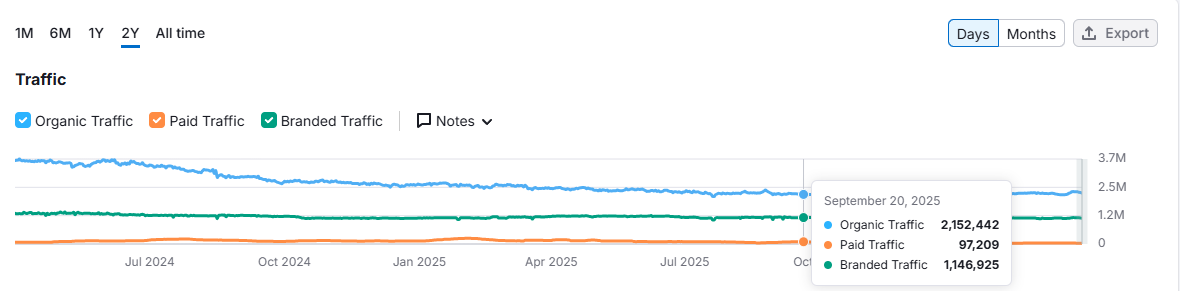
Over 50% of NA-KD’s organic traffic (1.14M of 2.15M sessions) comes from branded searches. While this reflects strong brand awareness, it also highlights a reliance on existing demand rather than scalable, non-branded growth. This suggests an opportunity to strengthen visibility for high-intent, non-branded keywords where competitors are currently capturing search demand.
NA-KD has a strong share of branded search traffic, which helps capture users already familiar with the brand. This supports consistent, high-intent traffic.
While NA-KD ranks well for some broad terms like “dresses,” visibility across more specific, long-tail category keywords remains limited.
This reliance on brand-led traffic highlights an opportunity to expand into non-branded search, where competitors like ASOS and H&M are capturing a wider range of search demand.
Using SEMrush’s keyword gap analysis, I compared NA-KD with competitors like Nelly and & Other Stories within the dress category.
Keywords like "green dress for women" (4.4K Vol) and "satin wrap dress" (1K Vol) have accessible Keyword Difficulty (11-20%), yet NA-KD is invisible. This is not due to a lack of products, but rather how the site is structured. Competitors capture this demand through dedicated, indexable subcategory pages, while NA-KD relies on dynamic filters that are not optimised for search visibility.
Many of these keywords rank just outside page one, indicating strong potential for quick gains with structural improvements.
NA-KD has little to no presence for commercially valuable keywords tied to colour, style, and occasion.
Competitors like Nelly and & Other Stories capture this demand through clearer subcategory structures and targeted pages.
The gap lies in site architecture rather than content. Creating dedicated, indexable pages for these modifiers would unlock additional search demand.
NA-KD must strengthen its category architecture by deploying static, indexable URLs for high-value modifiers (colour, occasion, fabric).
This would improve visibility for high-intent, non-branded searches and support scalable organic growth.
NA-KD’s magazine section generates strong top-of-funnel traffic through informational queries such as “what colour shoes go with a green dress.”
These articles are already performing well in organic search and show that the magazine can attract relevant users at the discovery stage.
Some of the strongest-performing examples highlighted in the analysis include:
However, despite their ability to generate visibility and traffic, there are still key gaps in how these pages connect users to products. As a result, NA-KD is not fully converting this editorial traffic into meaningful commercial value.
Source: Semrush Organic Traffic for /magazine/ directory.
Magazine articles rely on static images and basic text links to products. Given the fast-changing nature of fashion inventory, many of these links lead to out-of-stock products, creating a disconnect between inspiration and purchase.
Recommendation: Replace static links with dynamic “Shop the Look” modules connected to live product feeds. This ensures users are shown in-stock items with current pricing, improving the transition from content to purchase.
Some articles link to temporary campaign URLs (e.g., /campaigns/...), which become inactive over time. This results in outdated or broken links, negatively impacting both user experience and SEO value.
Recommendation: Prioritise linking to permanent category pages (e.g., /category/dresses) instead of campaign-specific URLs. This ensures long-term SEO value and a more stable internal linking structure.
When users land on empty categories (e.g., “Yellow Bags”), they are shown a generic message along with unrelated product recommendations, such as winter coats.
This creates a poor user experience and increases the likelihood of users leaving the site. From an SEO perspective, such pages can be interpreted as soft 404s, which may impact their ability to remain indexed.
Recommendation: Implement category-specific fallback logic.
For example, if "Yellow Bags" are unavailable, surface visually or contextually similar products from related categories (e.g., other bags or accessories).
Update messaging to be more user-friendly, such as: "Yellow bags are currently sold out, but explore these similar styles."
Audit Finding: NA-KD's empty category experience.
Competitor Benchmark: & Other Stories' detailed product pages.
Product pages rely on minimal descriptions, focusing primarily on basic attributes. In comparison, competitors like & Other Stories provide more detailed information, including material composition, care instructions, and fit guidance.
This limits visibility for long-tail product searches and can reduce user confidence during the purchase decision.
Recommendation: Enhance product pages with richer content, including:
Improving these areas would strengthen both user experience and conversion efficiency across the product journey.
With the rapid integration of Answer Engine Optimization (AEO) and AI Overviews, user search behavior is shifting toward conversational, long-form questions. The SEMrush data above shows how AI visibility is tracked. Currently, NA-KD's competitors, such as & Other Stories, rely on standard paragraph text and are not optimized for this shift, presenting a massive first-mover advantage to capture AI-generated search real estate.
To capture this emerging demand, NA-KD must move beyond traditional keyword targeting and implement visible, user-friendly FAQ modules at the bottom of the newly structured category pages.